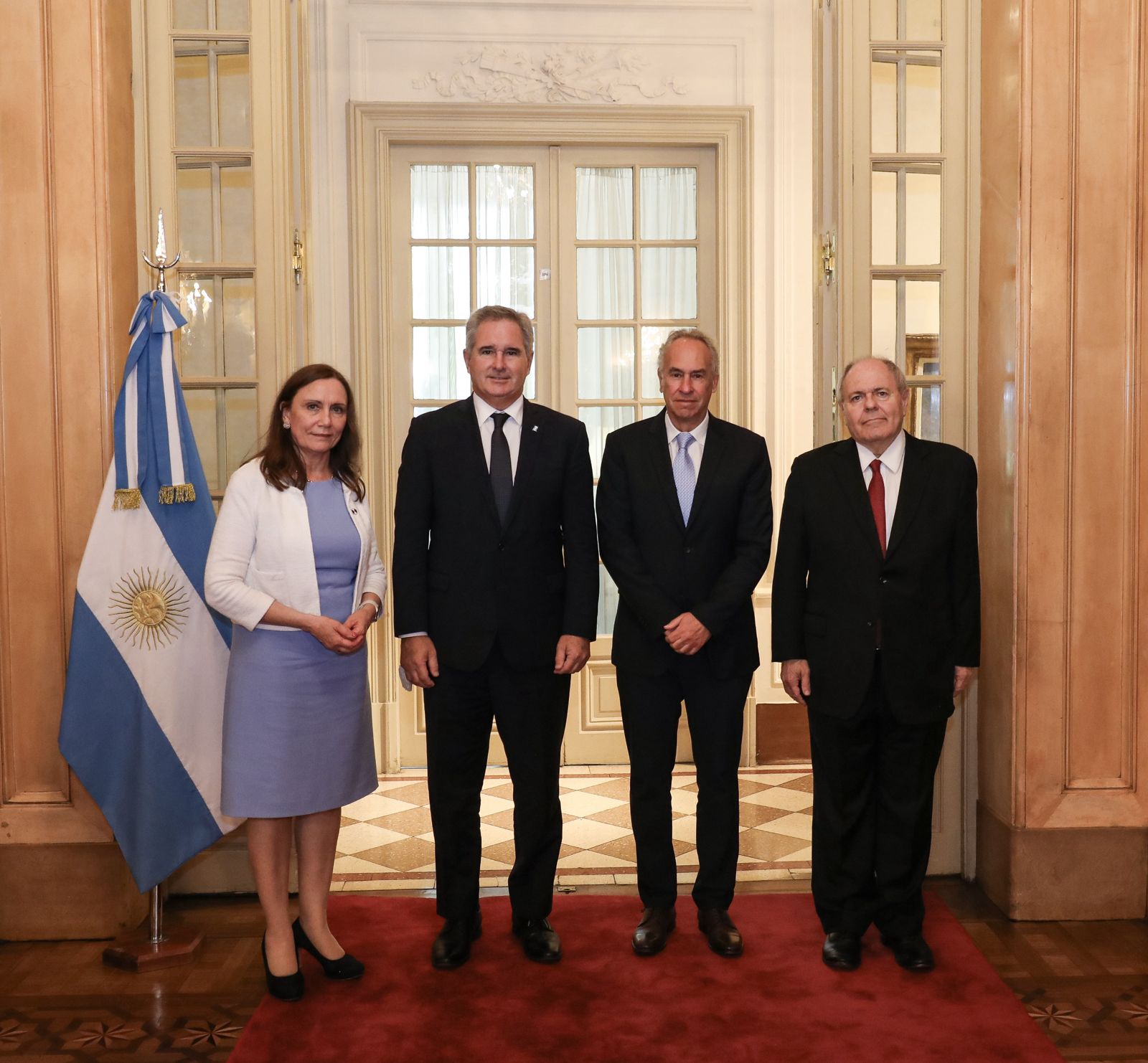

The Argentine Republic has assumed the Presidency of the International Holocaust Remembrance Alliance (IHRA), an intergovernmental organization that brings together governments and experts to promote Holocaust education, research, and remembrance worldwide, as well as the fight against antisemitism.
Argentina’s Presidency will be guided by the motto “Expanding the Frontiers of Remembrance” and marks a milestone for the organization, as it is the first time that a South American country has taken on this responsibility.
The handover from Israel to Argentina took place at the San Martín Palace in a ceremony attended by the Minister of Foreign Affairs, International Trade and Worship, Pablo Quirno; the Director of the Buenos Aires Holocaust Museum, Marcelo Mindlin, in his capacity as incoming IHRA Chair; the IHRA Executive Secretary, Michaela Küchler; the outgoing IHRA Chair, Dani Dayan; members of the local IHRA chapter; and representatives of the Argentine Jewish community.
During the handover ceremony, Minister Quirno stated that “the IHRA Presidency holds special significance. It is not the result of chance. It reflects a vision and a political decision. It comes because Argentina has understood that safeguarding the memory of the Holocaust is part of a broader struggle against falsehood, against fanaticism, and against all forms of moral degradation that threaten free societies.”
By decision of President Javier Milei, Argentina’s Presidency will be exercised by Marcelo Mindlin, in coordination with the Argentine Ministry of Foreign Affairs. Mindlin noted that “governments of different political orientations have, for more than 20 years, agreed on the importance of being part of IHRA and of developing policies on Holocaust education and remembrance. There is no doubt that this true state policy has contributed to President Milei’s valuable decision to assume the Presidency. A clear example of this sustained effort is the adoption, by the Argentine State and the judiciary, as well as by civil society organizations and other public bodies, of the IHRA working definition of antisemitism. This is a crucial tool to combat antisemitism, and our country can proudly point to the success of its implementation.”
In another segment of the ceremony, outgoing IHRA Chair Dani Dayan underlined that he is confident that “under Argentina’s leadership, IHRA will continue to expand its reach and deepen its impact. We particularly look forward to hearing more voices from Spanish-speaking countries and communities as they join IHRA’s mission.”
Likewise, IHRA Executive Secretary Michaela Küchler stated that “IHRA is now crossing the equator for the first time in its history. This is more than a geographical milestone. It is a reminder that the responsibility to remember the Holocaust and the genocide of the Roma people belongs to the entire world.”
Two IHRA plenary meetings will be held in Buenos Aires. The first will take place from 1 to 4 June, and the second from 2 to 5 November.
It is worth noting that more than 5,000 Holocaust survivors arrived in Argentina after the Second World War, making the country home to one of the largest survivor communities in South America. Today, approximately 150 of them still live in Argentina.
By assuming the IHRA Presidency, Argentina reaffirms its commitment to education, research, and the preservation of the memory of the Holocaust and the Roma genocide, as well as to combating antisemitism, with the aim of ensuring that their lessons continue to resonate across borders and generations.
Contacts
• For more information about the International Holocaust Remembrance Alliance, please contact Mara Antoce at mara.antoce@plmr.co.uk or +44 (0)785 284 4323.
• For further details on Argentina’s Presidency, please contact the Argentine Special Representation to the International Holocaust Remembrance Alliance at reamh@cancilleria.gob.ar.
About IHRA
The International Holocaust Remembrance Alliance (IHRA) brings together governments and experts to strengthen, advance, and promote Holocaust education, remembrance, and research worldwide, and to uphold the commitments of the 2000 Stockholm Declaration and the 2020 IHRA Ministerial Declaration.